
C ARNIVORES
Updated: 01/06/2016
Copyright - 2005-2016
All rights reserved
Change is Coming
Smithfield Foods & Maple Leaf Foods Are Phasing Out Cruel Gestation Crates
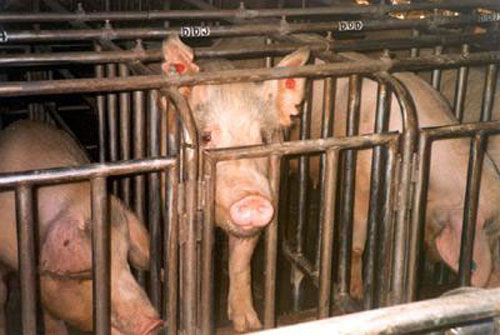
On January 25, 2007, Smithfield Foods, the largest US pork supplier,
announced that it would require its producers to phase out the practice of
keeping pregnant pigs in "gestation crates" in its U.S. operations.
Gestation crates are metal & concrete cages that animal welfare advocates
consider one of the most inhumane features of large-scale factory farming.
More than 1 million mother pigs are confined by Smithfield to gestation
crates.
A few days later, Maple Leaf Foods, the largest pork supplier in Canada,
announced that it would follow suit. Maple Leaf said it was responding to
consumer concerns in making the change, & followed the lead of Smithfield
Foods Inc. Maple Leaf cited Smithfield's move as the primary reason why it,
too, decided to get rid of gestation crates.
These decisions will significantly reduce the suffering of millions of pigs.
Gestation stalls have been the target of a well-organized campaign by animal
welfare groups in Canada, which have taken life-sized models of sows in the
stalls to public places, such as shopping malls, to gain support for ending
the practice.
Smithfield's sows, which the company says grow to an average of 400 to 450
pounds during gestation, are kept in 2-by-7-foot metal crates during their
four-month pregnancies.

Mother pigs are confined for their entire lives to cages made of metal
bars & cement floors. These crates are so small that the pigs cannot turn
around or take more than one step forward or backward. Mother pigs in
gestation crates often go insane from the complete isolation & boredom.
They also suffer as their bones & muscles painfully waste away from lack
of use. Productive sows will spend several years in the cages while giving
birth to five to eight litters. As the sows get larger over the years, some
cannot fit in the cages & are either slaughtered or forced to live in
conditions where they can sleep only on their chests, rather than their
sides as they do normally.
Thousands of animal rights activists in Florida & Arizona worked to pass
statewide bans on gestation crates. This Smithfield victory shows how caring
people can make a major difference in changing how giant companies treat
animals. Smithfield is making the change because customers "have told us
they feel group housing is a more animal-friendly form of sow housing," C.
Larry Pope, chief executive of the Smithfield-based company, said in a
statement.
Smithfield Foods Inc. said it will phase out gestation stalls or crates at
all 187 sow farms it owns in eight states & replace them with "more
animal-friendly" group housing pens over the next decade. The group pens
Smithfield is considering could house from six to 55 sows, depending on the
size of the barns. Group pens give sows some room to move & the ability
to socialize. All Smithfield-owned pig nurseries would be converted within
10 years, & contract growers will be eventually expected to move in that
direction.
It will be very hard for other companies to not follow Smithfield's lead.
The crates have been banned in Europe for some time.
Read "The Hidden Lives of Pigs." - They are intelligent, friendly, social
animals.
C
OMPASSIONATE
C
ARNIVORES